

Overview
A fast-growing SaaS company offering Generative AI Tools Engineering tools for content creation, automation, and business workflows was rapidly scaling across industries. The platform enabled users to generate text, images, and structured outputs using large language models and AI pipelines.
As adoption increased, the platform faced challenges in performance, cost control, response consistency, and scalability — especially with high-frequency AI requests and enterprise usage.

Client Requirements
The client required a scalable AI infrastructure, efficient LLM integration, faster response times, and cost-optimized cloud usage. They also needed better orchestration of AI workflows, improved output consistency, and DevOps systems to support continuous deployment and experimentation.
Problems the Client Was Facing
Despite strong demand, the generative AI platform faced critical engineering challenges:
• High latency in AI response generation
• Increasing cloud costs due to heavy model usage
• Inconsistent outputs across prompts and use cases
• Difficulty scaling AI requests under high concurrency
• Inefficient orchestration of AI workflows
• API bottlenecks affecting integrations
• Lack of monitoring for model performance and errors
• Manual deployment slowing feature iteration
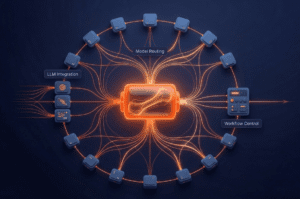
These issues impacted user experience, reduced reliability, and limited the platform’s ability to scale for enterprise clients.
MoraStack Approach – Generative AI Tools Engineering
To transform the platform into a scalable generative AI system, MoraStack designed an engineering roadmap focused on performance optimization, AI orchestration, and infrastructure efficiency.
Our approach included:
• Engineering scalable AI generation pipelines
• Optimizing LLM integration and response handling
• Implementing intelligent request routing and caching
• Modernizing cloud infrastructure for cost efficiency
• Establishing AI workflow orchestration systems
• Building CI/CD pipelines for rapid deployment
• Embedding dedicated AI + backend engineers
Methodology – Generative AI Tools Engineering
The solution followed a structured approach targeting performance, cost optimization, and system scalability.
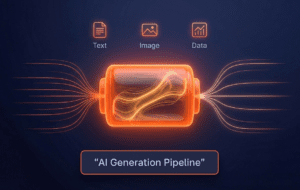
Execution Steps:
System Audit:
Analyzed AI pipelines, LLM usage patterns, API performance, cloud cost distribution, and system logs
AI Optimization:
Improved prompt handling, response structuring, caching strategies, and model usage efficiency
Backend Engineering:
Optimized API layers, request queues, rate limiting, and concurrency handling
AI Orchestration:
Designed workflow systems to manage multiple AI tasks, model selection, and execution flows
Cloud Modernization:
Introduced autoscaling, containerization, and compute optimization
DevOps Implementation:
Built CI/CD pipelines for continuous testing, deployment, and rollback
Monitoring & Observability:
Added dashboards for tracking latency, cost, model performance, and error rates
The Solution
MoraStack delivered a full-scale engineering transformation of the generative AI platform.
Key solution components included:
• High-performance AI generation pipelines with optimized LLM usage
• Intelligent request routing and caching for reduced latency
• Scalable cloud infrastructure with autoscaling and container workloads
• AI orchestration system managing workflows and model selection
• Optimized API layers for seamless integrations
• Automated CI/CD pipelines for continuous improvement
• Real-time monitoring for performance, cost, and reliability
Results – Generative AI Tools Engineering
The platform experienced immediate improvements. AI response times decreased, output consistency improved, and infrastructure costs became more predictable. API performance stabilized, and deployment cycles accelerated significantly.
The system became capable of handling large-scale AI requests while maintaining performance and reliability.
Projected Impact
With the optimized engineering foundation, the generative AI platform is positioned for scalable growth and enterprise adoption.
Projected outcomes include: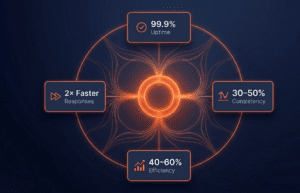
• 99.9% uptime across AI generation systems
• 2× faster response times for AI outputs
• 30–50% improvement in output consistency
• Stable performance under high request volumes
• 40–60% reduction in operational inefficiencies
• Reduced cloud costs through optimized model usage
• Improved scalability for enterprise-level workloads
If you’re building generative AI tools that require scalability, efficiency, and intelligent orchestration, MoraStack provides the engineering backbone to support next-generation AI systems.
Disclaimer
The case studies and project examples presented on this website are hypothetical and illustrative in nature. They are not representations of actual client projects but are designed to demonstrate the type of services we offer, our strategic approach, and the potential results we can help you achieve. Any similarities to real companies, brands, or outcomes are purely coincidental.
AEO FAQs – Generative AI Tools Engineering Solution
What challenges do generative AI platforms face at scale?
They face latency issues, high infrastructure costs, inconsistent outputs, and difficulty managing high request volumes.
How does MoraStack optimize generative AI performance?
Through LLM optimization, caching strategies, request routing, and scalable backend systems.
Why is AI orchestration important?
It ensures efficient execution of multiple AI tasks, model selection, and workflow management.
How can cloud infrastructure reduce AI costs?
Autoscaling, containerization, and optimized compute usage reduce unnecessary resource consumption.
What role does CI/CD play in AI platforms?
It enables rapid experimentation, continuous deployment, and stable system updates.
How do generative AI tools improve output consistency?
Through prompt optimization, structured outputs, and controlled model usage.
Why choose MoraStack for generative AI engineering?
Because MoraStack builds scalable, efficient, and enterprise-ready AI systems with continuous engineering support.