

MoraStack Helped a B2B SaaS Scale from Monolith to Microservices
OVERVIEW
This is a representative scenario illustrating how MoraStack approaches B2B SaaS Backened a common engineering challenge faced by growing SaaS companies: a legacy backend that has hit its scaling ceiling as the product gains traction.
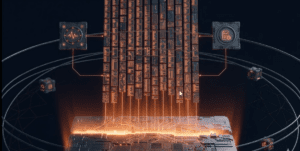
The hypothetical client is a B2B SaaS platform in the HR tech space, serving mid-market companies across Southeast Asia. The B2B SaaS Backened team had grown from 5 to 40 engineers over 18 months, but the core infrastructure was never re-architected to support that growth. What started as a fast MVP was now a liability.
CLIENT REQUIREMENTS – B2B SaaS Backened
- Handle 10x user growth without re-platforming the entire product
- Reduce deployment time from 4 days to same-day releases
- Improve system uptime to 99.9% SLA for enterprise contracts
- Introduce AI-assisted features (smart reporting, anomaly detection) without destabilizing the existing stack
- Maintain a lean engineering team while scaling product delivery

CORE PROBLEMS IDENTIFIED
- Monolithic architecture tightly coupled across all product modules — a single change in payroll logic required full regression testing across the entire app
- No CI/CD pipeline — deployments were manual, error-prone, and delayed by cross-team coordination
- Single-region cloud setup with no failover — any infrastructure incident meant full downtime
- Data layer not structured for AI/ML readiness — unstructured logs, no event schema, no data warehouse
- Engineering team organized by function rather than product domain — causing constant context switching and delivery delays
MORASTACK APPROACH – B2B SaaS Backened
MoraStack’s engagement started with a two-week architecture review before writing a single line of new code. The principle: understand the system’s load patterns, failure points, and team dependencies before proposing changes.
The approach mapped each identified problem to a specific engineering decision — not a tool preference, but a structural choice. The monolith was not ripped out. It was modularized incrementally using a strangler fig pattern so the product team could keep shipping while the platform was being re-engineered underneath them.
Delivery model used:
Dedicated Engineering Team — embedded with the client’s internal engineers to transfer knowledge, not create dependency.
METHODOLOGY
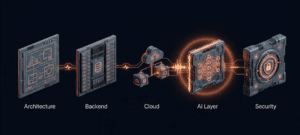
Phase 1 — Architecture Design (Weeks 1–2)

- Domain mapping across the existing monolith
- Identification of bounded contexts for modular extraction
- Cloud architecture design for multi-region active-passive setup
- Data schema standardization plan for AI readiness
Phase 2 — Backend Engineering (Weeks 3–8)
- Extraction of payroll, reporting, and user management modules as independently deployable services
- API gateway layer introduced to route traffic without breaking existing integrations
- Event-driven architecture introduced for async workloads (notifications, report generation, audit logs)
Phase 3 — Cloud Infrastructure & DevOps (Weeks 6–10)
- Migration from single-region to multi-region deployment on AWS
- CI/CD pipeline built with automated testing gates — no deployment without green builds
- Infrastructure as Code (IaC) implemented so environments are reproducible and version-controlled
Phase 4 — AI/Automation Layer (Weeks 9–12)
- Data warehouse introduced (structured event logs fed from the new event-driven layer)
- Anomaly detection pipeline built on top of cleaned data streams
- Smart reporting module prototyped using the standardized data schema
Phase 5 — Security & Performance Optimization (Ongoing)
- Role-based access control reviewed and tightened across all new service boundaries
- Load testing at 15x projected peak traffic before go-live
- Monitoring and alerting dashboards set up for engineering and product leadership
SOLUTION IMPLEMENTED – B2B SaaS Backened
The final system was a modular, cloud-native backend with a clean separation between the legacy monolith (maintained for stability) and the new service layer (built for scale and speed). The two systems communicated through a well-defined internal API contract, allowing the team to migrate modules gradually rather than in a high-risk big bang release.
The CI/CD pipeline reduced deployment from a 4-day manual process to a 2-hour automated cycle. The multi-region setup introduced active-passive failover, with automated health checks routing traffic away from degraded nodes. The data layer was fully standardized, making the platform AI-ready for the first time — not as an add-on, but as a structural property of the system.
Tech approach: event-driven microservices, AWS multi-region, Infrastructure as Code, automated CI/CD, structured data layer for ML pipelines.
RESULTS (HYPOTHETICAL OUTCOMES) – B2B SaaS Backened
- Deployment cycle reduced from 4 days to under 2 hours
- System uptime improved to 99.95% in simulated load testing
- Infrastructure costs reduced by approximately 30% through right-sizing and reserved instance planning
- AI anomaly detection module operational within 12 weeks of engagement start
- Engineering team delivery velocity increased by an estimated 60% due to reduced cross-team dependency and cleaner module ownership
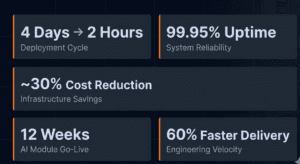
All figures are illustrative projections based on the described architectural changes, not actual client results.
FUTURE PROJECTIONS / SCALABILITY
The modular architecture means new product domains can be extracted and scaled independently. The AI layer — now fed by a clean, structured data stream — can support additional ML use cases: churn prediction, usage-based pricing models, predictive hiring analytics. The infrastructure is designed to support a 50x user base without re-architecture, only horizontal scaling.
MoraStack’s dedicated team model means the client’s internal engineers were trained alongside the engagement — reducing platform dependency and building long-term internal capability rather than creating an outsourcing lock-in.
If your engineering team is shipping slower than your product roadmap demands, the problem is usually not effort — it is architecture.
Talk to MoraStack about building a scalable backend, introdn ucing a CI/CD culture, or adding AI capabilities to your existing platform without destabilizing what already works.
Book a technical consultation → morastack
DISCLAIMER
The case studies and project examples presented are hypothetical and illustrative in nature. They are not representations of actual client projects but are designed to demonstrate the type of services we offer, our strategic approach, and the potential results we can help you achieve. Any similarities to real companies, brands, or outcomes are purely coincidental.
Here are the FAQs for this MoraStack case study:
FAQs – B2B SaaS Backened
Q1: What is the strangler fig pattern and why did MoraStack use it?
The strangler fig pattern is an incremental modernization technique where new services are built alongside a legacy system and gradually replace it — without a risky full rewrite. MoraStack applied it here so the client’s product team could keep shipping features while the platform was being re-engineered underneath them, eliminating downtime risk.
Q2: How long does B2B SaaS Backened take to migrate from a monolith to microservices?
In this scenario, the core migration was completed across a 12-week phased engagement — from architecture review through AI layer deployment. Timelines vary based on system complexity, but MoraStack’s phased approach (design → backend engineering → infrastructure → AI → security) ensures no single phase blocks product delivery.
Q3: How did MoraStack reduce B2B SaaS Backened deployment time from 4 days to 2 hours?
By building a fully automated CI/CD pipeline with mandatory testing gates — no deployment proceeds without a green build. Combined with Infrastructure as Code (IaC), environments became reproducible and version-controlled, eliminating the manual cross-team coordination that caused the original delays.
Q4: What does “AI-ready data infrastructure” actually mean?
It means the underlying data layer is structured, standardized, and event-driven — so ML models have clean inputs to work with. In this case, MoraStack introduced a data warehouse fed by event streams from the new service layer, making anomaly detection and smart reporting possible without rebuilding the data foundation later.
Q5: Can MoraStack work with an existing engineering team rather than replacing it?
Yes — MoraStack’s Dedicated Engineering Team model is designed for knowledge transfer, not dependency creation. In this engagement, MoraStack engineers were embedded alongside the client’s internal team, building capability and module ownership internally so the client exits the engagement with stronger in-house engineering.
Q6: What cloud infrastructure does MoraStack recommend for SaaS scalability?
For mid-market SaaS requiring enterprise-grade uptime, MoraStack recommends a multi-region active-passive setup on AWS with automated failover, load testing at 15x peak traffic, and full monitoring and alerting dashboards. This architecture supported a projected 99.95% uptime in simulated load testing.
Q7: How do you scale a B2B SaaS Backened without re-platforming the entire product?
Through domain-driven modularization — identifying bounded contexts within the monolith and extracting them as independently deployable services via an API gateway. The legacy core is preserved for stability while the new service layer handles scale. This approach avoids a high-risk “big bang” migration entirely.