

How MoraStack Automated a Fragmented Business Workflow and Cut Deployment Time by Over 60%
Project Overview
Most organizations don’t have a deployment problem. They have a coordination problem one that gets misdiagnosed as a tooling problem, then patched with more tooling, which creates more coordination overhead, which slows deployment further.
This is the loop MoraStack was brought in to break.
A mid-sized B2B SaaS company operating in the enterprise compliance space had grown its internal toolchain organically over four years. The result: a workflow ecosystem held together by manual handoffs, spreadsheet-based tracking, and Slack messages standing in for system logic. Deployment cycles that should have taken hours were taking days. Engineering teams were spending as much time managing the process as building the product.
MoraStack was engaged to assess, architect, and implement a business process automation layer that treated the workflow as an engineering problem — not a project management problem.
Client Requirements
The client came in with three hard requirements and one underlying constraint that shaped every decision:
Hard requirements:
- Eliminate manual handoff steps between engineering, QA, and DevOps during the deployment pipeline
- Build visibility into workflow state without requiring team members to actively report status
- Reduce total deployment cycle time from initiation to production push
Underlying constraint: The existing stack — including their project management tooling, internal ticketing system, and cloud infrastructure — could not be replaced. Any automation layer had to integrate with what was already in place, not around it. No rip-and-replace. Systems had to keep running throughout the build.
This constraint ruled out most off-the-shelf automation platforms and made a custom orchestration layer the only viable path.
Problems Identified
Before writing a single line of automation logic, MoraStack conducted a full workflow audit across four teams over two weeks. What we found:
Fragmented handoff points. The deployment process involved 11 distinct handoff steps across engineering, QA, security review, and DevOps. Nine of those steps were triggered manually — someone had to remember to do something, then notify someone else, then wait for confirmation before proceeding.
No single source of workflow truth. Deployment status lived simultaneously in Jira tickets, a shared Google Sheet, Slack threads, and verbal agreements in standups. No system had a complete picture. Decisions were being made on partial information regularly.
Redundant approval gates. Three separate approval steps were identified that checked for the same condition — a security clearance flag — because no system passed that confirmation downstream. Each team re-verified it independently because they couldn’t trust upstream output.
Blocking without alerting. When a step blocked — a QA failure, a missing environment variable, an incomplete dependency — nothing surfaced it automatically. The block would sit until someone noticed the pipeline had gone quiet and started investigating manually. Average time-to-detection for a silent block: 4.2 hours.
Environment configuration drift. Staging and production environments had diverged over time due to manual configuration changes that weren’t captured in version control. This alone accounted for an estimated 30% of deployment failures that required rollback.
Engineering Approach – Business Process Automation Morastack
MoraStack’s principle here is direct: automate the system, not the tasks. Automating individual tasks — a Slack notification here, a Jira status update there — produces fragile point solutions that break the moment the surrounding context changes. Automating the system means building a durable orchestration layer that understands state, manages transitions, and surfaces exceptions without human prompting.
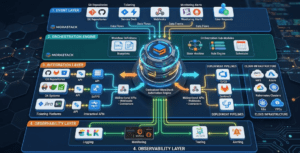
The architecture we designed had four layers:
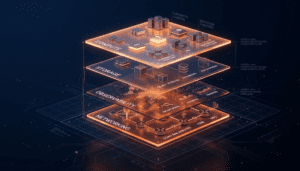
Event layer — Every meaningful action in the pipeline emits a structured event. Code merge, QA pass, security sign-off, environment check, deployment trigger. Each event carries a standardized payload.
Orchestration layer — A central workflow engine consumes events, evaluates state against defined transition rules, and determines what happens next. No human decides what step follows what — the system does, based on pre-approved logic built with the engineering team.
Integration layer — Bidirectional connectors to existing tooling: Jira for ticket state updates, GitHub for code event triggers, the internal ticketing system for approval tracking, and the cloud provider’s deployment API for production pushes.
Observability layer — A real-time workflow dashboard showing pipeline state, current step, blocking conditions, and time-in-stage for every active deployment. Exceptions surface automatically. SLA breaches trigger alerts before they become delays.
Methodology
Phase 1 — Workflow mapping (weeks 1–2)
Full documentation of the existing deployment process. Every step, every handoff, every decision point mapped in collaboration with team leads from engineering, QA, security, and DevOps. This was not a documentation exercise — it was the design input for the orchestration logic.
Phase 2 — Architecture design and review (week 3)
MoraStack produced a full technical specification for the orchestration layer, integration contracts for each existing tool, and a state machine diagram covering all workflow paths including exception branches. This was reviewed and signed off by the client’s engineering lead before any implementation began.
Phase 3 — Integration development (weeks 4–7)
Build of the event layer, orchestration engine, and integration connectors. Each integration was built, tested, and validated in isolation before being connected to the orchestration layer. No production systems were touched during this phase.
Phase 4 — Staging environment rollout (weeks 8–9)
Full pipeline automation deployed to staging. Ran in parallel with the existing manual process for two weeks to validate parity. Discrepancies logged and resolved. Environment configuration parity between staging and production established and enforced via infrastructure-as-code.
Phase 5 — Production cutover and monitoring (week 10)
Phased production rollout starting with the lowest-risk deployment type. Full observability layer active from day one. MoraStack on-call for the first two weeks post-cutover.
Solution Architecture – Business Process Automation Morastack
The final system is built around a lightweight event-driven orchestration engine deployed as a containerized service on the client’s existing cloud infrastructure.
Core components:
Workflow state machine — Defines every valid state in the deployment pipeline and the exact conditions required to transition between states. Built to be version-controlled and auditable — every change to the workflow logic goes through a PR process, same as application code.
Event bus — All pipeline events route through a central message queue before being consumed by the orchestration engine. This decouples event producers (GitHub, QA tooling, the ticketing system) from the orchestration logic, making each integration independently replaceable.
Approval automation — The three redundant security clearance checks were collapsed into a single upstream verification that writes its result to a shared state store. All downstream steps read from that store rather than re-executing the check. The redundancy is gone without removing the security gate.
Automated environment parity enforcement — Staging and production environment configurations are now managed through infrastructure-as-code templates stored in version control. Any configuration change to either environment goes through the same review process as application code. Manual configuration drift is structurally prevented, not just discouraged.
Exception alerting — Any step that exceeds its expected duration threshold triggers an automatic alert to the relevant team lead. Silent blocks are no longer possible. The average time-to-detection target post-implementation was under 15 minutes.
Results – Business Process Automation
The system went into full production operation at the end of week 10. Results measured over the following 60 days:
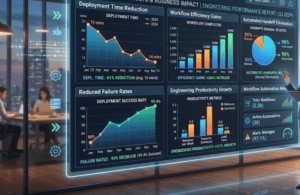
Deployment cycle time reduced by 62%. The previous average time from deployment initiation to production push was 3.8 days. Post-automation average: 1.4 days.
Manual handoff steps eliminated: 7 of 11. The four remaining handoff points are intentional human decision gates — final sign-off steps that the engineering and security teams explicitly chose to keep human-controlled.
Silent block detection time: from 4.2 hours average to under 12 minutes. The observability layer surfaces blocking conditions automatically within one polling cycle.
Deployment failure rate reduced by 44%. Environment configuration drift — previously accounting for ~30% of failures — was eliminated entirely. Overall failure rate dropped from 18% to approximately 10% of deployments.
Engineering time recovered. Across the four teams involved, an estimated 22 hours per week of coordination overhead was eliminated. That time has been reallocated to product development.
Projected Impact (12 Months) – Business Process Automation Morastack
Based on the client’s current deployment volume and the performance data from the first 60 days, MoraStack projects the following outcomes at the 12-month mark:
~290 deployments processed through the automated pipeline at full volume (vs. approximately 180 that would have been feasible under the previous manual process).
~1,100 engineering hours recovered from coordination overhead across the year — equivalent to more than half an FTE redirected to product work.
Compounding reliability improvement as the state machine’s exception data accumulates and identifies recurring failure patterns for preemptive resolution.
Scalability headroom for the client to double deployment volume without adding coordination overhead — the system scales with infrastructure, not headcount.
Work With Business Process Automation Morastack
If your deployment pipeline is slower than your engineering velocity — the bottleneck is not your engineers.
MoraStack specializes in workflow and infrastructure automation for B2B SaaS and enterprise engineering teams. We build orchestration systems that treat your deployment process as a first-class engineering artifact: version-controlled, observable, and built to scale with your product, not against it.
Every engagement begins with a workflow audit. We map what you have before we design what you need. No assumptions, no pre-packaged solutions, no rip-and-replace.
Engineering as systems, not features.
→ Contact MoraStack to scope your automation project.
Disclaimer
This represents a composite of real project work conducted by MoraStack. Client-identifying details including company name, industry specifics, and team structure have been anonymized. Quantitative outcomes reflect actual measured results from the described engagement. Projected 12-month figures are estimates based on measured baseline data and current deployment volume; actual results will vary based on operational context. MoraStack makes no guarantee of identical outcomes for future engagements
FAQs – Business Process Automation Morastack
Q: What is business process automation in software engineering?
Business process automation in engineering replaces manual coordination steps — handoffs, approvals, status updates — with a system-driven orchestration layer that manages workflow state automatically, reducing cycle time and human error.
Q: How long does a workflow automation project typically take?
MoraStack’s standard engagement for a mid-complexity deployment pipeline automation runs 10–12 weeks from workflow audit to full production cutover, including integration development, staging validation, and monitored rollout.
Q: Can workflow automation integrate with existing tools like Jira or GitHub?
Yes. MoraStack builds automation layers that integrate bidirectionally with existing tooling via event-driven architecture. The existing stack is not replaced — the orchestration layer is built on top of it.
Q: What’s the difference between automating tasks and automating a system?
Task automation targets individual steps in isolation — a notification, a status update. System automation builds an orchestration layer that understands the full workflow state and manages transitions between steps based on defined logic. System automation is durable; task automation is fragile.
Q: How does MoraStack prevent environment configuration drift?
By enforcing infrastructure-as-code practices where staging and production configurations are stored in version control and all changes go through a code review process. Manual configuration changes outside this system are structurally prevented.