
Business Process Automation — E-Commerce Operations
Project Overview
Most online stores don’t have a growth problem. They have a scale problem — one that surfaces only after volume increases, and by then, it’s already embedded in operations as manual workarounds, duplicate data entry, and reactive firefighting.
This is the condition MoraStack was brought in to resolve.
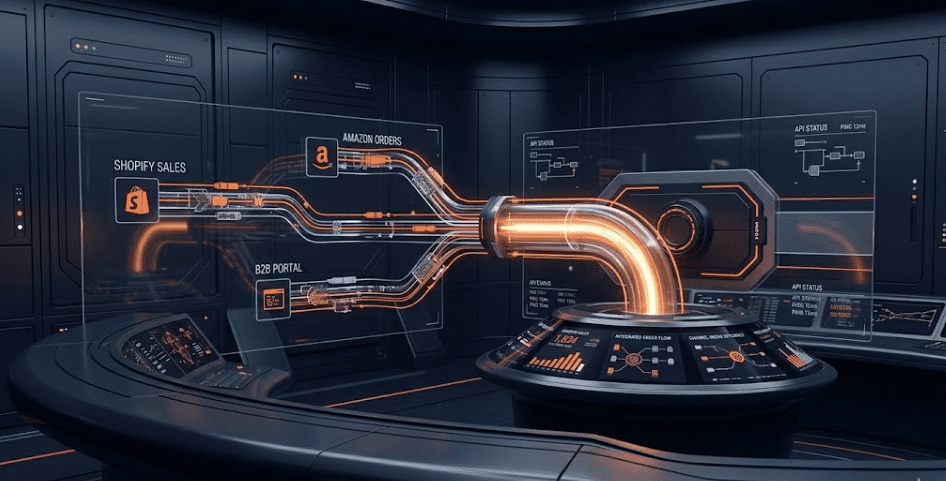
A direct-to-consumer e-commerce brand in the home goods category had scaled to approximately 1,800 monthly orders across three sales channels: a Shopify storefront, an Amazon Seller Central account, and a wholesale B2B portal with net-30 terms. Each channel had its own order management logic. None of them talked to each other in a way the business could rely on.
The result: a back-office operation running on spreadsheets, manual fulfillment triggers, and a customer service queue dominated by “where is my order” tickets that no one had the system visibility to answer quickly.

MoraStack was engaged to design and implement an automation layer that unified order flow, inventory state, and fulfillment logic across all three channels — without replacing the existing storefront, warehouse, or accounting stack.
Client Requirements – Automate Online Store Operations
The client presented four requirements Automate Online Store Operations and one non-negotiable constraint:
Hard requirements:
- Unify order intake across Shopify, Amazon, and the B2B portal into a single fulfillment workflow
- Automate inventory synchronization so overselling became structurally impossible
- Eliminate manual fulfillment triggers — warehouse team should receive pick-pack instructions automatically, not through Slack messages
- Reduce “where is my order” support volume by surfacing real-time order status to customers proactively
- Underlying constraint: The Shopify store, Amazon account, existing 3PL warehouse integration, and QuickBooks Online instance could not be replaced or significantly reconfigured. The automation layer had to connect what was already in place.
Problems Identified – Automate Online Store Operations
MoraStack conducted a two-week operational audit across the client’s order management, warehouse coordination, inventory tracking, and customer service workflows. Findings:
Fragmented order intake. Orders from three channels entered three separate systems with no unified view. The operations team manually reconciled channel data every morning before fulfillment could begin — a process averaging 2.3 hours daily.
Inventory managed by memory. Available inventory was tracked in a shared Google Sheet updated manually after each fulfillment run. The lag between actual stock movement and sheet update averaged 6–8 hours. Oversell incidents occurred on 4–6 SKUs per week during peak volume.
Fulfillment triggered by Slack. Pick-pack instructions were written manually and sent to the warehouse team via Slack messages. The warehouse had no direct system access to order data. A missed or misread message produced a fulfillment error.
Wholesale orders processed entirely manually. B2B orders required manual invoice generation in QuickBooks, manual confirmation to the buyer, and manual entry into the fulfillment queue. Average processing time per wholesale order: 47 minutes.
No proactive customer communication. Order status updates were sent manually after fulfillment. When a customer emailed asking for an update before that point, the support team had to manually check three systems to piece together an answer. Average resolution time for a status inquiry: 22 minutes.
Returns processed outside the system. Returns were tracked in a separate spreadsheet with no connection to inventory, no automatic restocking logic, and no trigger for refund processing. Returns that qualified for restock were sometimes lost or delayed for weeks.
Engineering Approach – Automate Online Store Operations
The principle applied here is the same one that governs every MoraStack engagement: automate the system, not the tasks.
Adding a Slack bot to remind the team to update the spreadsheet is task Automate Online Store Operations. It fails the moment the spreadsheet structure changes or someone forgets to respond. Building a unified order state machine that consumes events from all three channels, manages fulfillment transitions automatically, and keeps inventory state accurate in real time — that is system automation. It doesn’t fail when people are busy.
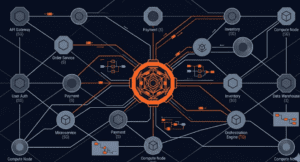
The architecture we designed had five layers:
Channel ingestion layer — Standardized event consumers for Shopify webhooks, Amazon SP-API order events, and B2B portal order submissions. Each incoming order is normalized into a unified order schema regardless of source channel.
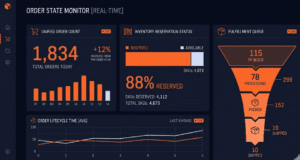
Order orchestration layer — A central state machine that tracks every order from placement through fulfillment to delivery and post-delivery. Transitions are driven by events — payment confirmation, inventory reservation, warehouse pick confirmation, shipping carrier scan, delivery confirmation — not by human action.
Inventory management layer — A real-time inventory ledger that reserves stock at the moment of order placement and decrements confirmed stock at the moment of fulfillment. Inventory state is the single source of truth for all three channels. Overselling is prevented at the reservation step, not discovered after the fact.
Integration layer — Bidirectional connectors to Shopify (order updates, inventory sync), Amazon (order acknowledgment, tracking upload), the 3PL warehouse API (automated pick-pack instruction delivery, confirmation receipt), and QuickBooks Online (automated invoice generation for wholesale orders).
Customer communication layer — Event-triggered transactional messaging that sends proactive order status updates at each fulfillment milestone: confirmation, warehouse receipt, shipping, out for delivery, delivered. No manual trigger required.
Methodology – Automate Online Store Operations
Phase 1 — Operational mapping (weeks 1–2)
Full documentation of the existing order-to-fulfillment process across all three channels. Every step, every handoff, every system interaction mapped with the operations, warehouse, and customer service teams. This mapping became the direct input for orchestration logic design.
Phase 2 — Architecture design and review (week 3)
Technical specification for the orchestration layer, integration contracts for each connected system, unified order schema definition, and inventory ledger design. Reviewed and approved by the client’s operations lead before implementation began.
Phase 3 — Integration development (weeks 4–8)
Build of the channel ingestion layer, order orchestration engine, inventory ledger, and all integration connectors. Each connector tested in isolation against sandbox environments before being connected to the orchestration layer.
Phase 4 — Parallel run and validation (weeks 9–10)
Full automation pipeline deployed alongside existing manual operations. Both systems ran simultaneously for two weeks. Output compared daily. Discrepancy rate targeted below 0.5% before manual process retirement.
Phase 5 — Production cutover and stabilization (week 11)
Phased cutover starting with Shopify-only order flow. Amazon and wholesale channels added on days 3 and 7 respectively. MoraStack monitoring active through week 13.
Solution Architecture – Automate Online Store Operations
The system is built as a containerized microservice architecture deployed on the client’s existing cloud infrastructure.
Core components:
- Unified order state machine — Defines every valid state across the order lifecycle and the exact conditions required to transition between them. Version-controlled. Every change to fulfillment logic goes through a review process before deployment.
- Real-time inventory ledger — Maintains confirmed stock, reserved stock, and available stock as distinct values updated on event trigger. Channel availability feeds are derived from the available stock value. Reservation holds expire automatically if payment is not confirmed within a defined window, releasing stock back to available.
- Automated wholesale processing — B2B orders entering the portal trigger an automated workflow: order acknowledgment to buyer, QuickBooks invoice generation, inventory reservation, and fulfillment queue entry. What previously took 47 minutes of manual processing now completes in under 90 seconds.
- Warehouse integration — Pick-pack instructions are generated automatically when an order reaches “ready for fulfillment” state and pushed directly to the 3PL’s order management system via API. No Slack message, no manual entry. Warehouse confirmation events flow back to the orchestration layer to advance order state.
- Returns automation — Return requests trigger an automated assessment flow: eligibility check against order data, return label generation, restocking flag assignment based on return reason code, and refund initiation upon warehouse receipt confirmation. Returns no longer require manual intervention unless escalation conditions are met.
Results – Automate Online Store Operations
The system reached full three-channel production operation at the end of week 11. Results measured over 60 days post-cutover:
- Morning reconciliation eliminated. The 2.3-hour daily manual reconciliation process no longer exists. Order state is unified in real time across all three channels.
- Oversell incidents: zero. In 60 days of operation at full volume, no oversell events occurred. The inventory reservation model structurally prevents it.
- Wholesale order processing time: 47 minutes → under 90 seconds. Full end-to-end automation from order receipt to fulfillment queue entry.
- “Where is my order” support tickets reduced by 71%. Proactive status messaging at each fulfillment milestone eliminated the majority of reactive status inquiries. Average support resolution time for remaining inquiries dropped from 22 minutes to 4 minutes due to unified order visibility.
- Returns processing time reduced by 83%. Automated eligibility assessment and refund initiation removed the primary manual bottleneck. Restock accuracy improved to 100% — no returns lost to spreadsheet lag.
- Total operational hours recovered: approximately 38 hours per week across the operations and customer service teams, reallocated to demand planning, supplier relations, and channel growth work.
Projected Impact (12 Months)
Based on current order volume trajectory and 60-day performance data:
- ~26,000 orders processed through the automated pipeline at projected volume — a throughput level the previous manual operation could not have sustained without significant headcount addition.
- ~1,980 operational hours recovered from coordination and manual processing work across the year — nearly a full FTE redirected to growth-oriented activity.
- Inventory accuracy compounding over time as the reservation ledger accumulates exception data that can inform reorder point optimization and safety stock modeling.
- Scale-readiness for 3–4x order volume growth without proportional increase in operational overhead — the system scales with infrastructure, not with staff.
Work With MoraStack Automate Online Store Operations
If your operations team is managing your order flow instead of growing your business — the bottleneck is not your team.
MoraStack builds automation infrastructure for e-commerce and B2B operations teams that have outgrown their manual processes. We design orchestration systems that treat your fulfillment workflow as a first-class engineering artifact: unified, observable, and built to scale with your volume, not against it.
Every engagement begins with an operational audit. We map what you have before we design what you need Automate Online Store Operations.
Engineering as systems, not features.
→ Contact MoraStack to scope your operations automation project.
Disclaimer
This solution represents a composite of real project work conducted by MoraStack. Client-identifying details including company name, product category, and team structure have been anonymized. Quantitative outcomes reflect actual measured results from the described engagement. Projected 12-month figures are estimates based on measured baseline data and current order volume trajectory; actual results will vary based on operational context. MoraStack makes no guarantee of identical outcomes for future engagements.
FAQs — Automate Online Store Operations
Q: What is Automate Online Store Operations?
E-commerce operations automation replaces manual order processing, inventory tracking, and fulfillment coordination with a system-driven orchestration layer that manages order state across all sales channels automatically — reducing processing time, eliminating errors, and freeing operations staff for higher-value work.
Q: Can this work across multiple sales channels simultaneously?
Yes. MoraStack’s architecture normalizes orders from any number of channels — Shopify, Amazon, wholesale portals, or custom storefronts — into a unified order schema. The orchestration layer manages fulfillment logic consistently regardless of order origin.
Q: How does automated inventory management prevent overselling?
By maintaining a real-time inventory ledger that reserves stock at the moment of order placement rather than at the point of fulfillment. Available inventory counts shown to each channel are derived from confirmed stock minus active reservations — not from a manually updated spreadsheet.
Q: How long does an e-commerce automation project take?
MoraStack’s standard engagement for a multi-channel order orchestration project runs 11–13 weeks from operational audit to full production cutover, including integration development, parallel validation, and monitored rollout.
Q: Does this require replacing our existing store or warehouse system?
No. MoraStack builds automation layers that integrate with existing storefronts, 3PL systems, and accounting tools via API. Your existing systems remain in place; the orchestration layer coordinates between them.