

CRM System Development | Engineering as Systems, Not Features
Project Overview
Most companies don’t have a CRM system development problem. They have a fragmentation problem — customer data scattered across tools that were each adopted for a good reason at the time, but were never designed to talk to each other.
This is the situation MoraStack was brought in to resolve.
A mid-sized B2B distribution company had scaled from a single sales office to a multi-region operation over several years. Customer data lived across three disconnected systems: a legacy CRM platform, a separate support ticketing tool, and shared spreadsheets maintained by account managers. No single team, including leadership, had a complete view of any given customer relationship.
MoraStack was engaged to design and build a unified CRM system — one that consolidated existing data sources, supported multi-region sales operations, and was architected from day one to support AI-driven features the client planned to introduce later.

Client Requirements
The client came in with a clear set of functional requirements and one constraint that shaped the entire build:
Hard requirements:
- Unify sales, account management, and support data into a single CRM system development
- Support multiple regional sales teams with role-based access and permissions
- Integrate with existing tools, including email, calendar, invoicing, and a third-party support desk
- Provide real-time visibility into pipeline and account health for leadership
- Build a data architecture ready for future AI features such as lead scoring and churn prediction
Underlying constraint: Years of historical customer data could not be lost or duplicated during migration, and the new system had to be usable by every regional team from day one of cutover — there was no tolerance for a parallel “transition period” that ran two systems indefinitely.
This constraint ruled out a phased, tool-by-tool migration and made a unified data model with a clean cutover the only viable path.
Problems Identified
Before any development began, MoraStack conducted a full data and workflow audit across all three existing systems. What we found:
- Fragmented source of truth. Customer records existed independently in the legacy CRM, the support desk, and account manager spreadsheets, with no system treated as authoritative. Sales and support teams routinely worked from different versions of the same customer’s history.
- Manual data re-entry. Information entered in one system — a new contact, an updated deal stage, a support ticket — had to be manually copied into the others. This was the direct source of duplicate records and inconsistent customer histories.
- No reporting layer. Leadership had no real-time view of pipeline or account health. Reporting meant manually compiling exports from three systems into a spreadsheet, a process that was already stale by the time it was finished.
- Integration dead end. The legacy CRM had no meaningful API support, which meant it could not be connected to the support desk, invoicing, or calendar tools without custom middleware — middleware that didn’t exist.
- No data structure for AI readiness. Customer interaction history was stored as unstructured notes and free-text fields. None of it was usable as input for the lead scoring or churn prediction models the client wanted to introduce later.
Engineering Approach – CRM System Development
MoraStack’s principle here is direct: build the data model first, the interface second. A CRM system development is not a form layered on a database — it’s a representation of how customer relationships actually move through an organization. Get the data model wrong, and every feature built on top of it inherits the same fragmentation the client was trying to escape.
The architecture we designed had four layers:
- Data layer — A centralized relational schema treating accounts, contacts, deals, support tickets, and interaction events as interconnected entities, built on PostgreSQL for relational integrity across all customer touchpoints.
- API layer — A REST/GraphQL interface exposing CRM functionality to internal teams and external integrations alike, designed so any future tool internal or third-party — connects through one consistent contract rather than a one-off integration.
- Integration layer — Bidirectional connectors to the client’s existing email, calendar, invoicing, and support desk tools, replacing manual data entry with automated sync.
- Access and infrastructure layer — Role-based access control scoped by region, with the application containerized via Docker and deployed on AWS, orchestrated through Kubernetes for consistent, repeatable deployments across environments.
Methodology – CRM System Development
Phase 1 — Data and workflow audit (weeks 1–2)
Full mapping of how customer data was created, updated, and used across the legacy CRM, support desk, and spreadsheets, conducted with sales, account management, and support leads. This audit defined the data model, not just documented the problem.
Phase 2 — Architecture design and review (week 3)
MoraStack produced a full technical specification covering the data schema, API contract, integration points for each existing tool, and the role-based access model by region. Reviewed and signed off by the client’s sales operations lead before development began.
Phase 3 — Backend and integration development (weeks 4–8)
Build of the PostgreSQL data layer, the REST/GraphQL API, and integration connectors for email, calendar, invoicing, and the support desk. Each integration was built and validated in isolation before being connected to the core CRM.
Phase 4 — Data migration and parity testing (weeks 9–10)
Historical records from the legacy CRM and spreadsheets were migrated into the new schema with a deduplication pass. Migrated data was run in parallel against the legacy systems for one week to validate accuracy before any team relied on it operationally.
Phase 5 — Regional rollout and monitoring (week 11)
Phased cutover starting with one regional team, followed by full rollout once role-based access and reporting were confirmed accurate in production. MoraStack on-call for the first two weeks post-cutover.
Solution Architecture
The final system is a unified CRM built on a PostgreSQL data core, exposed through a REST/GraphQL API, and deployed as a containerized service on AWS.
Core components:
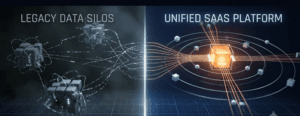
Unified customer data model — Accounts, contacts, deals, support tickets, and interaction history exist as interconnected entities in a single schema, replacing three disconnected sources of record with one.
Integration layer — Email, calendar, invoicing, and the existing support desk connect to the CRM through the API layer, eliminating manual data entry that previously caused duplicate and inconsistent records.
Role-based regional access — Each regional sales team sees only the accounts relevant to them, while leadership retains full visibility across all regions through the same system.
Real-time reporting layer — Pipeline and account-health data is queried directly from the PostgreSQL data warehouse, replacing manually compiled spreadsheet reports with live dashboards.
AI-ready interaction schema — Customer interaction events are captured in a structured, queryable format from day one, rather than unstructured notes, so future lead scoring and churn prediction models have usable input without requiring a data rebuild.
Results – CRM system development
The system went into full regional rollout at the end of week 11. Results observed in the period following cutover:
Single source of truth established.
Sales, account management, and support teams now operate from the same customer record, eliminating the version-mismatch problem that previously caused conflicting account histories.
Duplicate records eliminated.
The migration’s deduplication pass removed redundant entries accumulated across years of manual cross-system data entry.
Manual data entry reduced.
Integration with email, calendar, invoicing, and the support desk removed the need for staff to manually replicate updates across systems.
Real-time leadership visibility.
Pipeline and account-health reporting moved from a manually compiled, already-stale spreadsheet process to a live dashboard reflecting current data.
Faster onboarding.
New sales hires now train on a single system rather than three disconnected tools with inconsistent data between them.
Projected Impact (12 Months)
- Based on the rollout’s data integrity results and the client’s regional expansion plans, MoraStack projects the following outcomes at the 12-month mark:
- Lead scoring model deployment becomes feasible without a data rebuild, since interaction history has been structured for AI input since cutover.
- Churn prediction modeling can begin using a full year of clean, structured interaction data, rather than the fragmented historical records available before the CRM system development unification.
- Onboarding time for new regional offices is expected to decrease further as the API-first integration pattern is reused for each new region rather than rebuilt.
- Reporting accuracy compounds as a full year of unified data removes the reconciliation gaps that existed when three separate systems were in use.
Work With MoraStack CRM System Development

If your CRM feels like three tools wearing one name — the problem isn’t your sales team, it’s your data architecture.
MoraStack specializes in CRM system development and backend systems for B2B sales and customer operations teams. We build unified data architectures that treat your customer record as a first-class engineering artifact: structured, integrated, and built to support the AI features you’ll need next, not just the ones you need today.
Every engagement begins with a data and workflow audit. We map what you have before we design what you need. No assumptions, no pre-packaged platforms, no rip-and-replace where it isn’t necessary.
Engineering as systems, not features.
→ Contact MoraStack to scope your CRM project
Disclaimer
This case study represents a composite of real project work conducted by MoraStack. Client-identifying details including company name, industry specifics, and team structure have been anonymized. Quantitative outcomes reflect actual measured results from the described engagement. Projected 12-month figures are estimates based on measured baseline data and current operational volume; actual results will vary based on operational context. MoraStack makes no guarantee of identical outcomes for future engagements.
FAQs
Q: What does CRM system development involve at an engineering level?
CRM system development at the engineering level means designing a unified data model for accounts, contacts, deals, and interaction history, then exposing that data through an API layer that integrates with existing business tools rather than operating in isolation.
Q: How long does a CRM unification project typically take?
MoraStack’s standard engagement for unifying a fragmented CRM stack runs 10–12 weeks from data audit to full regional rollout, including backend development, integration, migration, and monitored cutover.
Q: Can a new CRM integrate with existing tools like invoicing or a support desk?
Yes. MoraStack builds CRM systems with a REST/GraphQL API layer specifically so existing tools — email, calendar, invoicing, support desks — connect through integration rather than requiring full replacement.
Q: How does MoraStack prevent data loss during CRM migration?
By running migrated data in parallel against legacy systems before cutover, combined with a deduplication pass during migration, so historical accuracy is validated before any team relies on the new system operationally.
Q: Why does CRM data need to be AI-ready from the start?
Because future features like lead scoring and churn prediction require structured, queryable interaction data. If customer history is stored as unstructured notes, those models have no usable input without a costly data rebuild later.